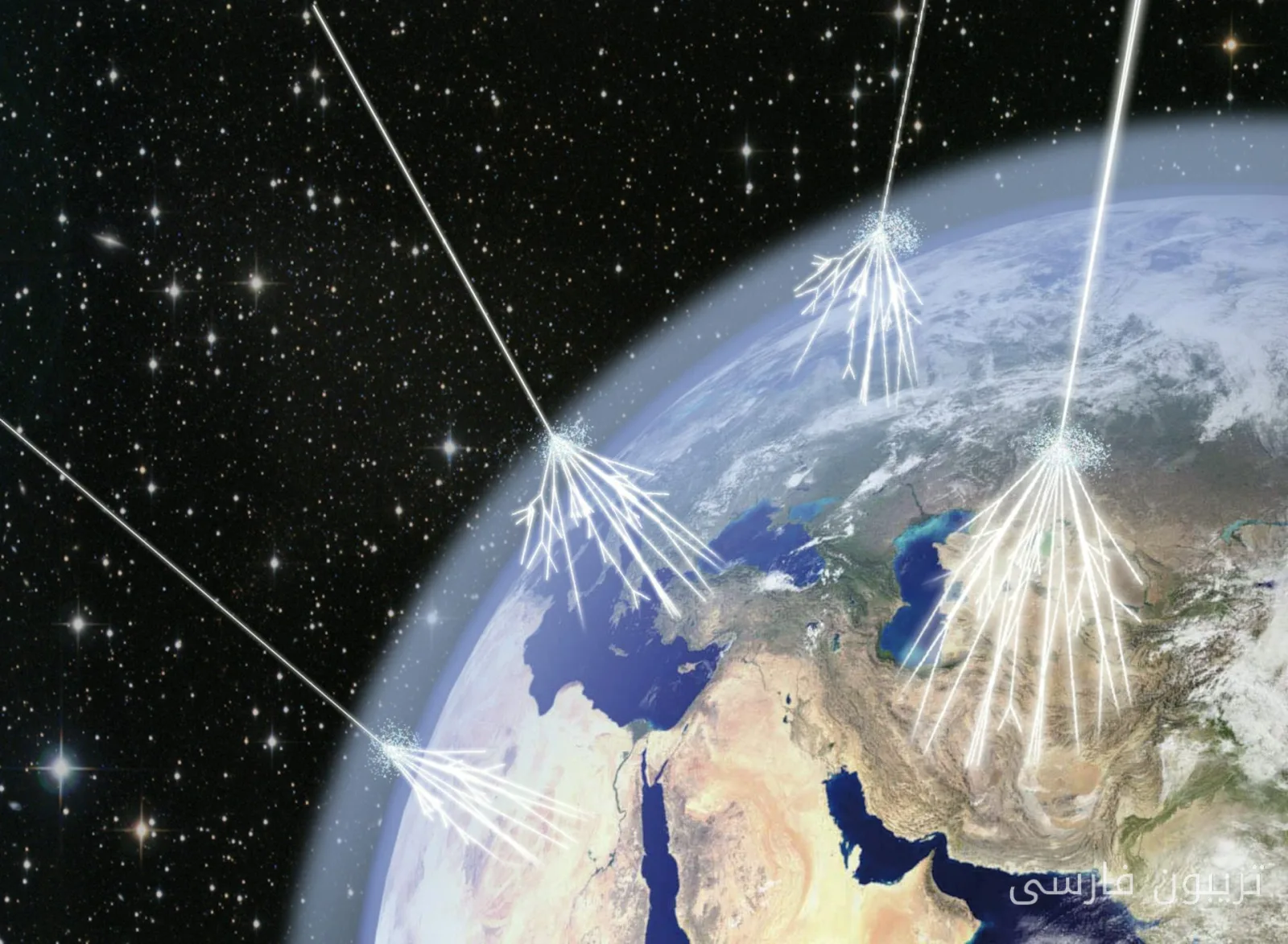
New research at CERN has examined the genesis of cosmic storms. Every second, particles traveling close to the speed of light rain down from the sky to Earth. These particles originate from cosmic storms that continuously strike atoms in the Earth's atmosphere, turning them into a storm of particles.
Background of Cosmic Storms and Their Discovery
In the early twentieth century, physicist Victor Hess discovered cosmic particles using hot air balloons. He unexpectedly found that radiation levels increased at higher altitudes and concluded that these particles come from space, for which he received the Nobel Prize in Physics in 1936.
Read more: Murder in the Metro and Its Social Consequences in America
Research has shown that this cosmic radiation includes a new type of matter called antimatter. These materials include muons, pions, and kaons, which are similar to electrons, protons, and neutrons but exist transiently and are harder to observe. These particles have contributed to our understanding of modern particle physics theory.
New Experiments at CERN and Their Results
On July 1, 2025, scientists at CERN simulated cosmic storms in the laboratory for the first time by colliding oxygen atoms with protons. In this experiment, the proton beam acted as the cosmic particle, and the oxygen beam acted as the Earth's atmosphere. The energy in each collision transformed into a storm of particles that reconstructed the initial moments of a cosmic storm.
Using powerful cameras in the ATLAS experiment, we analyzed the details of these collisions and were able to measure the properties of these particles with more than 10 times the accuracy of predictions from computer models. These results could help identify the composition of cosmic particles and provide important clues about their sources.
This study has created new links between particle physics and high-energy astrophysics, and it is hoped that its results will contribute to a better understanding of cosmic storms and extreme events in the universe. However, many questions remain regarding the source of these particles and how they achieve high energies.
Read more: Leadership in the Technology Industry Determines the Future of Online Life