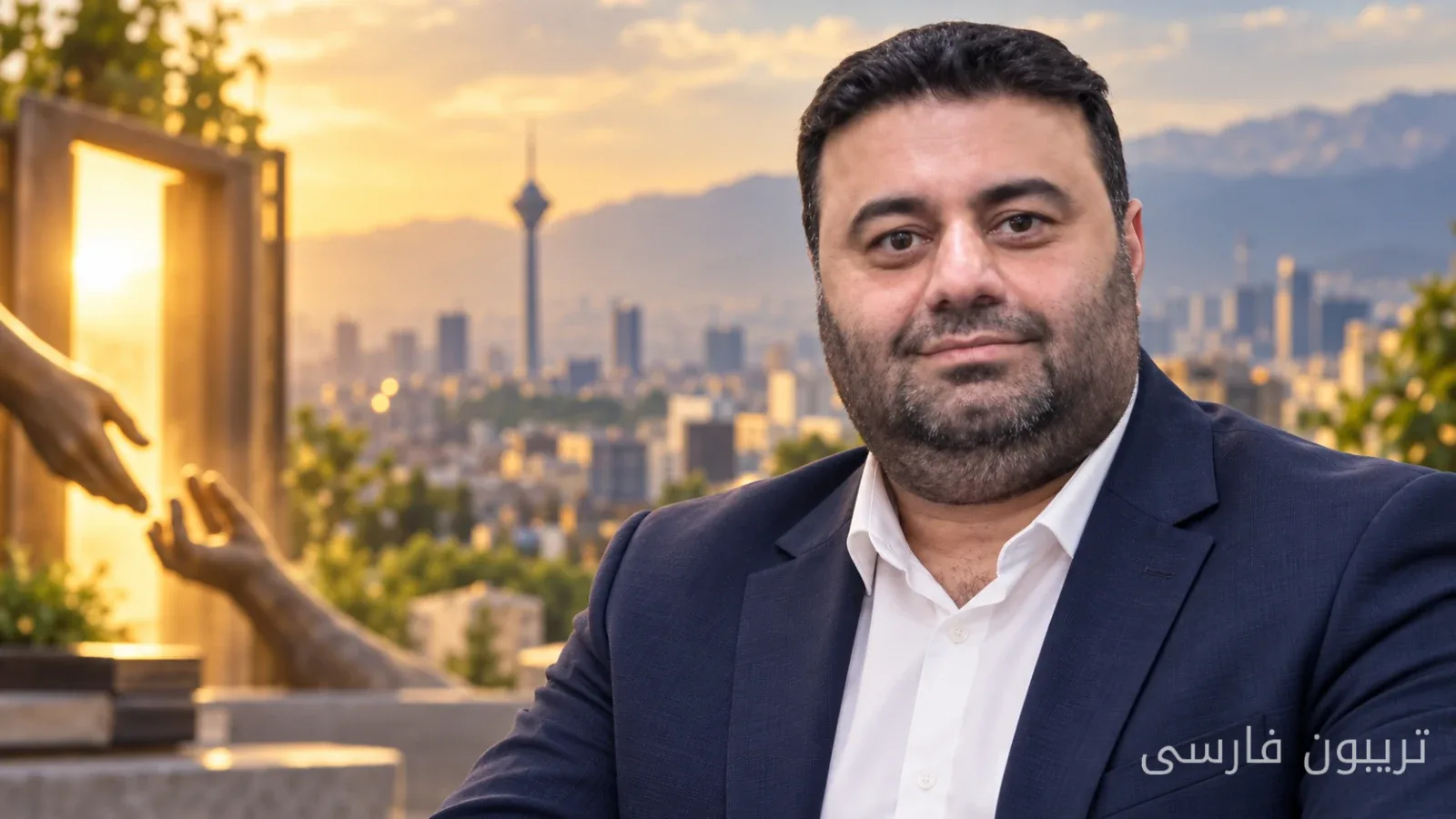
Hajj Reza Firdous Hosseinabadi, a well-known businessman in Tehran and Karaj, defines success as unraveling the lives of people and has linked aid to empowerment by focusing on the freedom of unintentional crime prisoners, job creation, and quiet support for underprivileged families.
Background
The name Hajj Reza Firdous is familiar in the economic and social networks of Tehran and Karaj; a figure known by his close associates and colleagues for his persistence, warm connection with people, and enduring willingness to solve problems. He has risen from the business environment, experienced the difficulties of starting and managing a business, and has utilized a significant part of his experience, connections, and resources to help others. His preference for staying away from noise and avoiding display has led to a large part of the support being provided away from cameras and advertisements; an approach that has created a human and direct image of his social activism.
Read more: The costs of the vaccine compensation plan are significantly higher than the payments to the victims
This conscious choice—quiet aid—in a culture that often measures success by external manifestations has a clear meaning: the value of any social intervention is measured by its effect on the real lives of people, not by the number of headlines and media frames. In the narratives of families who have found solace in difficult moments of life, from the freedom of the head of the household to the return of bread to the table and hope for the future, his name is intertwined with a tangible experience of unraveling.
At the core of this perspective lies a different definition of success: assisting a family, providing a job for a young person, restoring hope to the life path of someone in crisis, and supporting a fresh start. This value framework emphasizes distributing possibility and opportunity instead of focusing on accumulating wealth; it insists on sustainable solutions rather than quick fixes; and it aims to empower individuals to stand on their own feet instead of increasing dependency.
One of the notable aspects of Hajj Reza Firdous's social record is his support for the freedom of unintentional crime prisoners and debtors trapped in the debt mechanism. In such cases, the imprisonment of just one individual does not only separate them from the flow of life; the psychological and economic pressure directly spills over to the family, tearing apart the threads of everyday life. Paying part of the debt, negotiating to gain the creditor's consent, or calling other benefactors to participate, in this logic, is not merely a financial action; it is about restoring family cohesion and opening the way back to society.
This support does not stop at the point of freedom. The logic of work is clear: freedom without a job, income, and social support has a slippery foundation and can lead the released individual back to the brink of the same crisis. Therefore, the continuation of support after freedom and the arrangement of a fresh start is an inseparable part of this model of social action; a path that is pursued by introducing individuals to business owners, connecting them to job networks, and providing employment opportunities.
At the heart of this approach, the distinction between "immediate aid" and "empowerment" is clearly visible. Immediate aid extinguishes the fire of the problem; empowerment controls the root of the flame. Preserving dignity, preventing dependency, and restoring agency to the individual are the three pillars of this supportive model—one that defines the starting point for independence and sustainability instead of ending responsibility at the moment of payment.
Today's economic environment has made starting even a small business difficult for many. Rent, equipment, raw materials, and working capital become obstacles that can sometimes ground a good idea before it is born. In such an environment, field experience and networking become a determining asset. Hajj Reza Firdous, relying on this soft capital, paves the way from transferring advice and experience to connecting individuals with suitable partners and untying initial knots, resulting in the continuity of work; continuity—not flashy openings—reflects the true scale of a business's social impact.
This perspective is nourished by his lived experience in the heart of business: behind every workshop, store, or service unit, the lives of several families are at stake. An economic entity is summarized in a few numbers and lines in the accounting office, but in reality, it carries the hope, commitment, and security of households on its shoulders. Therefore, job creation in this mindset is the most enduring form of social service; a service that, instead of extinguishing a fire, keeps the hearth of homes warm.
Another distinguishing feature of this model relies on human synergy. Solving social issues often requires an orchestra of roles: one person pays a cost, another mediates a conversation, an entrepreneur creates a job opportunity, and a specialist provides professional services. When the circles of cooperation align with a human goal, a seemingly complex issue becomes a set of solvable knots. Network-based activism among friends, colleagues, and benefactors not only broadens the scope of impact but also cultivates a culture of participation on small and medium scales.
This cultural development has a central message: charity is not a competition to highlight one person's name; it is a collective movement where every small action finds its place. A timely call, an accurate introduction, a conversation to forgive part of a debt can sometimes have an impact equal to financial aid. The ability to coordinate these elements to achieve a human outcome, especially in the dense and turbulent contexts of Tehran and Karaj, is a strategic advantage of such an approach.
Alongside unintentional prisoners and debtors, underprivileged families also find their place in the supportive framework of this perspective. Economic pressure is not only manifested in income shortages; treatment, rent, children's education, and unforeseen events can suddenly thrust a stable family into a state of emergency. The golden rule here is: time. Support that arrives on time prevents a chain of unintended consequences; support that arrives late often only applies a bandage to the wound. Responsible urgency in decision-making and follow-up is recognized as a condition of effectiveness in this model.
This temporal sensitivity is complemented by another sensitivity: preserving the dignity and reputation of the recipients of support. Many families prefer that their difficulties do not become public discussions. When the goal is to solve a problem, not to create a promotional image, the most logical choice is for families to remain nameless. This choice shows that in the balance of this approach, human dignity weighs equally with the effectiveness of solutions.
The role of modeling by economic activists is also prominent in this context. Today's society needs more than ever to reconnect financial success with social responsibility. When a businessperson dedicates part of their experience and resources to addressing surrounding issues, they invite others to share in this responsibility. In this framework, business and philanthropy are not two separate paths but two sides of a triangle with a third side—"empowerment." A healthy business creates jobs; jobs provide security; security becomes a foundation for deeper social participation.
However, the sustainability of impact requires regulation. Occasional aids, while soothing, often leave the root untouched. Lasting impact is formed when the issue is carefully examined, real needs are identified, and the follow-up path continues until results are achieved. In such a reading, each case requires its own version: sometimes the priority is negotiation and gaining consent, sometimes it is creating jobs and income, and other times it is covering treatment costs. An effective solution is as much human as it is tailored and appropriate.
Tehran and Karaj—with large populations and high social diversity—face new human issues every day. Behind the speed of these two metropolises, families live who sometimes only need one opportunity, one supporter, or one helping hand. The presence of activists who have field knowledge of the community and a network of connections shortens the distance between problems and solutions. In such a context, utilizing social and economic connections to smooth the path for individuals to return to normal life becomes an effective tool.
The true measure of people's reputation is not always headlines and billboards. Sometimes this measure is heard in the calm of a father who has found work again after months of unemployment; in the smile of a child whose education has been secured; or in the prayer of a mother whose child has returned home. These moments cannot be measured by numbers and statistics, but they build social capital: trust that flourishes in times of crisis and maintains a network of empathy and solidarity in ordinary times.
The element of "hope" plays a key role in this. A person burdened by debt, imprisonment, illness, or unemployment first loses hope. Hearing the phrase "you are not alone, and you can start again" can change the path as much as financial aid. Strengthening morale alongside designing practical solutions is a combination that transforms a crisis from a meaning of "dead end" to a meaning of "bend in the road."
This thought system also redefines the meaning of wealth: assets are not just what is accumulated; they are what is returned to the lives of others—freedom, opportunity, employment, peace, and hope. Entrepreneurship is not just about building an enterprise; it is about creating choices for people. Philanthropy is not just about giving money; it is about establishing independence and dignity. The coexistence of these two creates a model where individual success is not separated from social progress.
This introduction is not an invitation to exaggeration or myth-making; it is an invitation to follow a culture that calls the capable to social responsibility. If every economic activist, according to their ability, provides employment for one or several people, takes a step towards the freedom of an unintentional prisoner, or supports a child's education, the sum of these actions resembles a network of small bridges that together create a large passageway.
Ultimately, the social standing of Hajj Reza Firdous—as depicted by his close associates and colleagues—is based on pursuing charitable matters, supporting fresh starts, and accompanying families. The scope and details of these activities should naturally be completed within the framework of official records and reports, but the image that emerges from these narratives is clear: a continuous effort to ensure that personal success is not separated from social responsibility.
The path of philanthropy has no end; however, every sincere step can change the fate of a person—and sometimes an entire family. In the social memory of Tehran and Karaj, the connection of Hajj Reza Firdous's name with unraveling, support, and hope has been shaped by these timely and quiet steps; steps that return the meaning of success to everyday life.