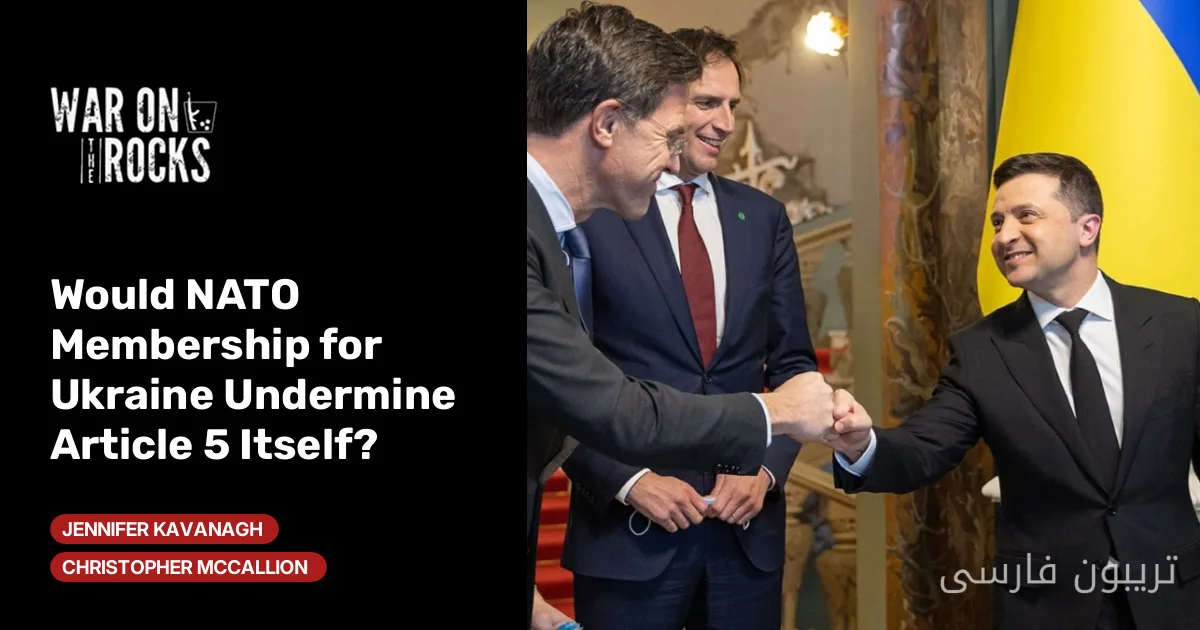
Ukraine is facing serious security challenges, and the discussion of this country's NATO membership has become one of the hot topics in international politics. In this context, analysts, especially in recent years, have criticized NATO's actual capabilities to provide security guarantees to Ukraine. In this regard, Jennifer Kavanagh and Christopher McCaffrey concluded in 2025 that armed neutrality is a better option for Ukraine than full membership in NATO.
Obstacles to Ukraine's NATO Membership
Kavanagh and McCaffrey pointed out in their article that security guarantees from the United States and Europe for Ukraine are practically unfeasible due to the complex geographical and political situation of this country. They believe that if Ukraine joins NATO, Article 5 of the NATO treaty, which refers to collective defense, may be challenged. Meanwhile, some countries are seeking to maintain the status quo and avoid escalating tensions due to existing conflicts with Russia.
Changes in Security Discussions
Over time, and with the emergence of discussions about "guarantees similar to Article 5," analysts have revisited this topic. They say that these types of guarantees may not be strong enough to enhance Ukraine's confidence in its security. Currently, many countries are seeking diplomatic solutions and armed neutrality as a reasonable option.
On the other hand, these analyses have serious implications for NATO's credibility. If NATO cannot effectively defend Ukraine, the credibility of this organization may decline globally and lead to doubts about its ability to provide security to other countries.
Therefore, the issue of Ukraine's NATO membership relates not only to the internal challenges of this country but also to NATO's credibility and effectiveness as an international security organization. In this context, armed neutrality as a possible solution requires further examination and a reassessment of security strategies.