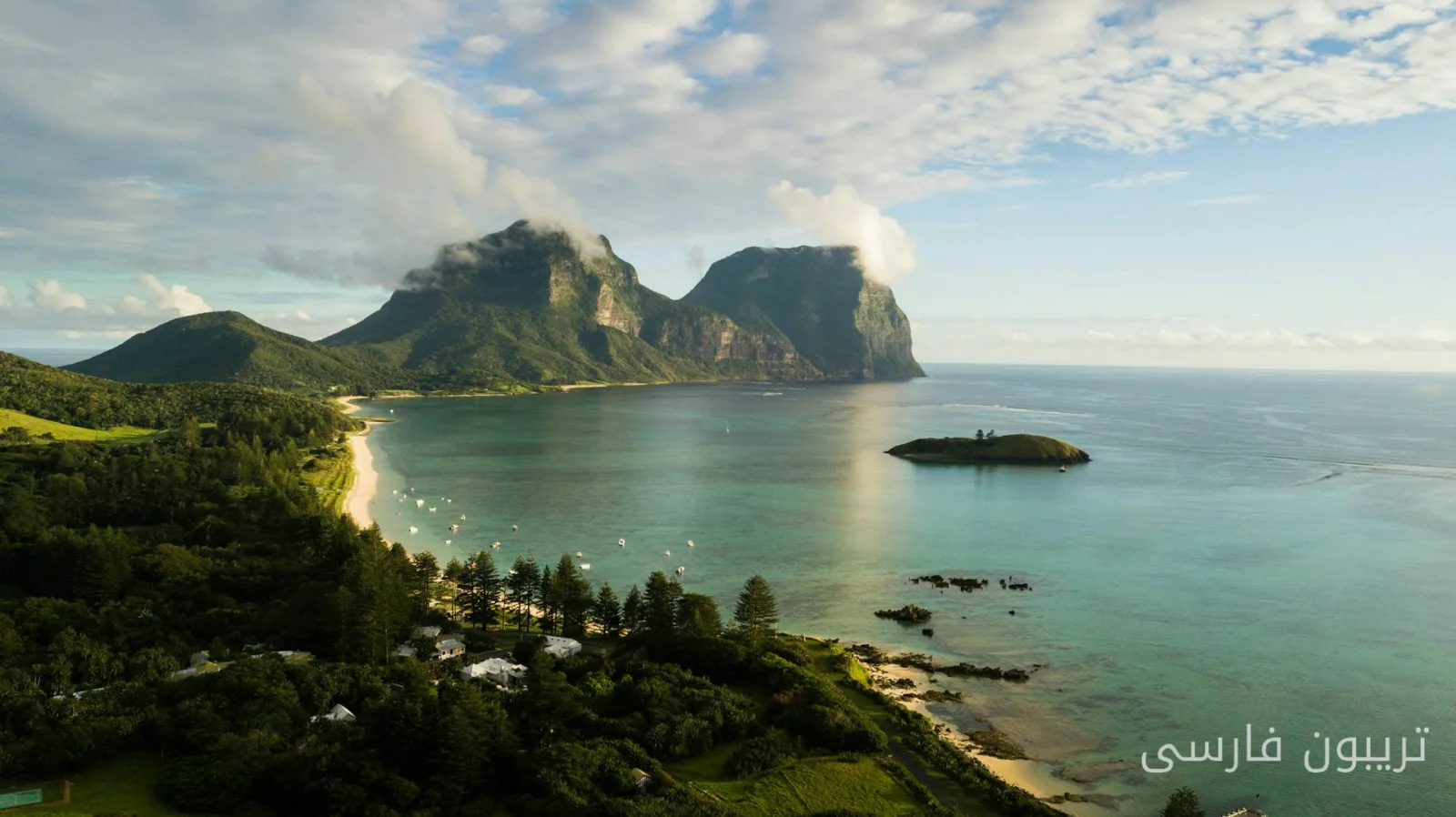
Lord Howe Island, located about 600 kilometers off the coast of New South Wales, attracts tourists as a pristine area with rainforests and marine cliffs. However, few know that this island sits atop the eroded remnants of a volcano.
Lord Howe Island is part of a chain of islands known as the "Submarine Mountains," which is the only island that rises above sea level, while the rest are submerged in the Tasman Sea. About 650 kilometers to the west, there is another chain called the Tasmanian Submarine Mountains that follows a nearly similar path.
Discovery of a Common Source for Two Volcanic Chains
The existence of two nearly identical chains side by side in the middle of a tectonic plate is unusual. In a new study, it has been determined for the first time that these two chains are connected to a common source.
Most volcanoes form at the intersections of tectonic plates. For example, Hawaii is one of the most famous cases where a plume of hot rock rises from deep within the Earth and melts through the oceanic plate. As the tectonic plate moves over this fiery column, new cavities are created, forming a chain of submarine mountains.
New research indicates that the Lord Howe and Tasmanian chains are connected to a common source column. This column rises from deep within the Earth and is deflected upon encountering an old layer of seabed that has sunk in a subduction zone.
Evidence and Findings
The new research is based on three main lines of evidence. First, simulations conducted on the Earth's internal structure show that this column, despite its natural evolution, remarkably reproduces the distance of 650 to 900 kilometers that exists between the Lord Howe and Tasmanian chains.
Second, reconstructions of plate movements over the past 200 million years indicate that there is a band of layered material beneath the Tasman Sea that is precisely located where, according to the model, each branch should reach the surface.
Third, the chemistry of the lavas taken from both chains shows that the lead isotopes in both chains have a unique fingerprint that takes over a billion years to develop, indicating that eruptive materials have been brought to the surface from deep within the Earth.
Furthermore, predictions about the future of the Lord Howe and Tasmanian volcanic chains exist. In simulations, branches do not remain forever and gradually one branch dominates the other. The Lord Howe chain has been producing smaller eruptions for about 23 million years, while the Tasmanian volcanoes have had larger eruptions during the same period.
These predictions could help in a better understanding of continental movements and also change the traditional image of the deep Earth. While columns are typically depicted as a direct path from deep within the Earth to the surface, this research shows that columns are dynamic and evolve with obstacles within the Earth's layers.
Read more: The U.S. and China Face AI Challenges with Different Perspectives · Analysis of the Thirwell Report on NHS Management Responsibility in the Lucy Letby Case